

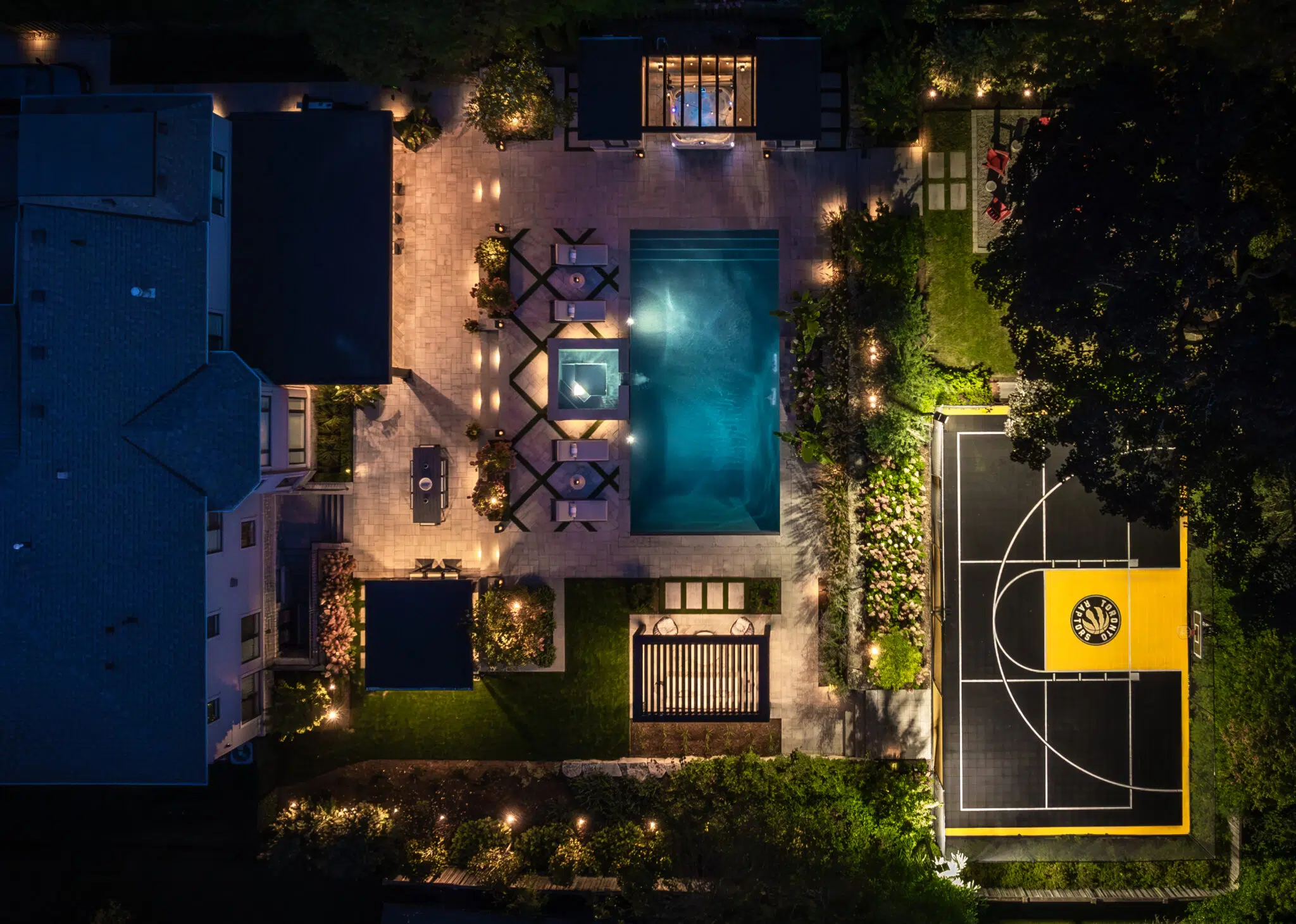
If you’re planning a significant backyard investment, understanding the most common landscaping mistakes Oakville homeowners make can protect your budget, timeline, and long-term property value.
In established neighbourhoods like Morrison, Old Oakville, Glen Abbey, and Bronte East, we regularly see projects that looked beautiful at installation but began failing within a few seasons. The issue is rarely the stone or plant selection. It’s almost always planning.
This guide outlines the most common landscaping mistakes in Oakville backyards, why they happen, and practical landscape planning tips to avoid them.
The Most Costly Landscaping Mistakes in Oakville Backyards
1. Designing for Inspiration Photos Instead of Ontario Conditions
One of the most common landscaping mistakes Oakville homeowners make is designing around inspiration photos from warmer climates.
Many online examples come from California or the southern U.S., where freeze–thaw cycles are not a structural concern. In Southern Ontario, winter ground movement is unavoidable.
According to Natural Resources Canada (https://natural-resources.canada.ca), frost penetration depth in Ontario can significantly impact structural installations. Without proper base depth and compaction, patios and retaining walls will shift over time.
What most homeowners don’t realize
Clay-heavy soils common throughout Halton Region expand and contract dramatically with moisture. The Halton Region (https://www.halton.ca) identifies clay composition as a factor in drainage performance and grading strategy.
If base preparation doesn’t account for this movement, surface materials will eventually fail.
Landscape planning tip: Design from the ground up. Drainage, base depth, and soil conditions must be engineered before selecting finishes.
Drainage Is One of the Biggest Landscaping Mistakes Oakville Properties Face
Poor water management is one of the most expensive mistakes to correct after installation.
The Town of Oakville (https://www.oakville.ca) outlines grading and drainage requirements for residential properties. Altering drainage patterns without proper planning can cause:
- Water pooling near foundations
- Runoff issues with neighbours
- Failed inspections
- Required rework
From our experience in Oakville
We frequently see patios installed too flat against the home for aesthetic reasons. After a heavy spring thaw, water tracks back toward the foundation.
Correcting slope after hardscape installation can cost significantly more than addressing it during design.
Landscape planning tip: Include a drainage and grading plan in your design documentation, not just in construction discussions.
3. Overbuilding Without a Master Plan
It’s easy to get excited and include everything at once:
- Pool
- Cabana
- Outdoor kitchen
- Fire feature
- Full property lighting
- Extensive planting package
But without a cohesive plan, these elements compete for space and budget.
A common mistake we see
Homeowners build a patio sized for current needs. Two years later, they add a pool and realize circulation space no longer works.
Phasing only works if there’s a full-property master plan guiding each stage.
4. Ignoring Permit and Bylaw Requirements
Oakville has specific regulations governing:
- Pool enclosures
- Lot coverage
- Setbacks
- Tree protection zones
The Town of Oakville Building Services (https://www.oakville.ca/home-environment/building-permits.html) provides permit guidance, yet many projects begin excavation before confirming requirements.
Mid-project permit corrections can cause delays, added costs, or required redesigns.
Landscape planning tip: Confirm permit triggers during the design phase, not after construction begins.
5. Choosing Contractors Based on Price Alone
In competitive markets like Oakville, pricing can vary widely.
Lower quotes often reflect differences in:
- Base preparation depth
- Drainage integration
- Design documentation
- Project management oversight
The Landscape Ontario Horticultural Trades Association (https://landscapeontario.com) recommends working with qualified, insured landscape professionals for structural installations.
Budget Reality Check
A properly built interlock patio in Oakville requires excavation depth appropriate for frost conditions. If pricing seems dramatically lower, ask:
- What base depth is included?
- Is drainage integrated?
- Are permits managed?
- Is there a full design plan?
Significant price gaps usually reflect scope gaps.
6. Skipping the Design Phase Entirely
This mistake often creates all the others.
Hiring a contractor without a detailed design plan can lead to:
- Change orders
- Budget creep
- Compromised layout decisions
- Mid-build frustration
A structured design-build approach aligns scope, engineering, budget, and permits before construction starts. If you’re evaluating how this works, our design-build process page outlines each step.
How to Avoid Landscaping Mistakes in Oakville
Avoiding landscaping mistakes in Oakville starts with clarity and structure.
Here are practical landscape planning tips:
- Establish a realistic budget range before design begins
- Conduct a drainage and grading assessment first
- Confirm municipal permit requirements early
- Develop a full-property master plan, even if phasing
- Choose a design-build team that manages both planning and execution
Planning properly does not necessarily increase cost. It reduces correction risk.
Should You Hire a Landscape Designer Before Talking to a Contractor?
This is a common mid-project question.
Designer-first models can work well for complex properties, especially when independent design oversight is desired.
However, in many Oakville backyards, a design-build firm can streamline:
- Budget alignment
- Constructability review
- Permit coordination
- Timeline forecasting
When design and construction teams collaborate from the beginning, fewer surprises occur during installation.
You can learn more about our approach on our About page.
Timeline Reality Check for Oakville Backyard Projects
One overlooked landscaping mistake Oakville homeowners make is underestimating timeline.
Typical planning framework:
- Design development: 4–8 weeks
- Permit approvals: variable depending on scope
- Peak build season: May through October
- Premium material lead times: can extend during high demand
Starting planning in winter or early spring often creates smoother construction timelines.
Why Professional Landscape Planning Matters in Oakville
Oakville properties often involve:
- Tight lot lines
- Mature tree preservation
- Drainage sensitivity
- Elevated property values
- High aesthetic expectations
Professional planning:
- Identifies structural risks early
- Aligns vision with realistic budget tiers
- Accounts for Ontario freeze–thaw movement
- Reduces mid-project design revisions
For significant backyard investments, this planning stage protects long-term performance.
FAQs About Landscaping Mistakes in Oakville
What is the most expensive landscaping mistake to fix?
Drainage and structural base failures are typically the most costly. Rebuilding a shifting patio or correcting improper grading can require full removal and reconstruction.
Do I need permits for backyard landscaping in Oakville?
It depends on scope. Pools, significant structures, retaining walls above certain heights, and lot grading changes often require permits. Always confirm with the Town before construction.
How much contingency should I budget?
For larger backyard projects, many homeowners allocate 5–10 percent contingency for unforeseen site conditions, particularly in older neighbourhoods.
Final Thoughts on Landscaping Mistakes Oakville Homeowners Can Avoid
The most expensive landscaping mistakes in Oakville are rarely about materials.
They’re about planning.
If you’re preparing for a meaningful backyard investment, the right design conversation early can prevent costly revisions later. Starting with a structured consultation ensures drainage, engineering, permitting, and long-term layout are aligned before construction begins.
If you’re considering a project this season or next, you can begin the conversation through our Contact page.
Good landscaping isn’t just about how it looks in year one.
It’s about how it performs in year ten.