

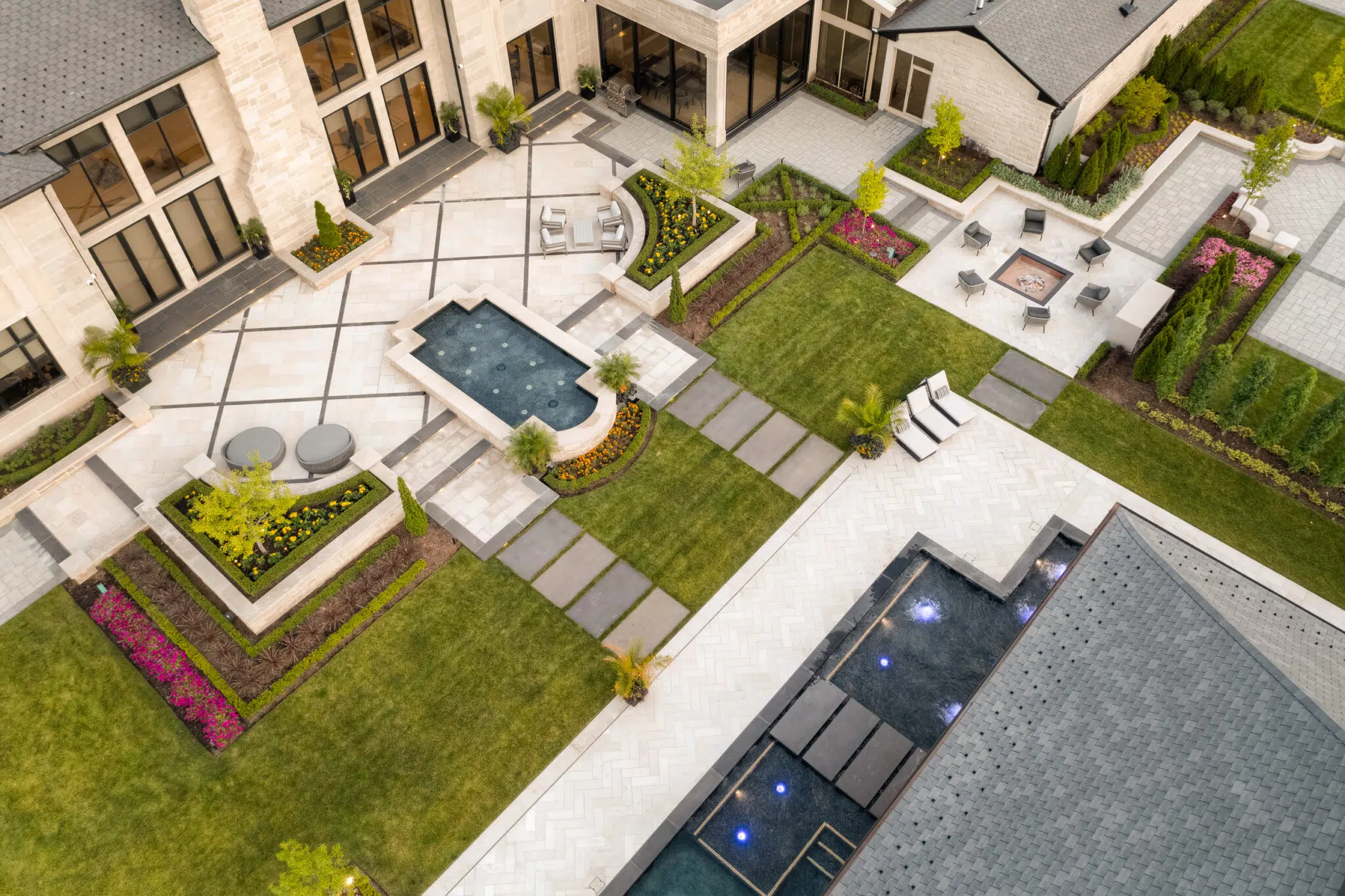
When homeowners begin researching Oakville landscapers, portfolios often look similar at first glance. Beautiful patios. Refined planting plans. Resort-style backyards.
But landscape design in Oakville is not just about aesthetics.
It is about understanding local soil conditions, tree protection bylaws, watershed constraints, microclimates, and Ontario’s freeze–thaw cycles. Without that contextual knowledge, even well-designed spaces can underperform over time.
For homeowners planning a $40,000 to $150,000+ outdoor investment, local experience is not a bonus feature. It is risk management.
Oakville’s Freeze–Thaw Cycles Shape Every Hardscape Decision
Southern Ontario experiences repeated freeze–thaw fluctuations throughout winter and early spring. According to Environment and Climate Change Canada (https://climate.weather.gc.ca), temperatures regularly move above and below freezing within short timeframes.
That movement affects:
- Interlocking stone patios
- Retaining walls
- Outdoor steps
- Drainage systems
- Pool decking
In clay-heavy areas of Oakville, frost expansion can be more pronounced if base preparation is insufficient.
From our experience in Oakville:
The most common long-term failure we see is not product-related. It is base-preparation-related. The unseen structural layers beneath your patio determine how it performs five winters from now.
This is where experienced Oakville landscapers differentiate themselves — in what happens below grade.
Soil and Drainage Conditions Vary Across Oakville Neighbourhoods
Oakville’s proximity to Lake Ontario and its varied topography create meaningful differences between neighbourhoods.
- Old Oakville and Morrison often feature mature lots with compacted soils and established tree roots.
- Glen Abbey properties frequently include subtle grading shifts.
- Bronte and southeast areas may experience increased wind exposure and lake-influenced moisture.
Heavy clay soils, common throughout Halton Region, drain slowly and expand when saturated. The Ontario Ministry of Agriculture, Food and Rural Affairs (OMAFRA) (http://www.omafra.gov.on.ca) notes that clay soils require careful drainage management to prevent structural movement and water accumulation.
What most homeowners don’t realize:
Beautiful planting beds and patios fail not because of materials, but because subsurface water management was never addressed properly.
Drainage planning is design work — not an afterthought.
Tree Protection Bylaws Influence Design Before Construction Begins
Oakville’s established canopy is one of its defining features. It is also regulated.
The Town of Oakville (https://www.oakville.ca) enforces tree protection bylaws that can affect excavation, grading, and hardscape placement. Root protection zones must be respected, and certain removals require permits.
In neighbourhoods like Old Oakville or Morrison, this can significantly shape design decisions.
A common mistake we see:
Homeowners finalize patio or pool layouts before understanding how tree protection zones affect placement.
Experienced local landscape designers plan around these realities from the start, avoiding costly redesigns and delays.
Watershed and Grading Considerations Matter More Than You Think
Oakville falls within the jurisdiction of Conservation Halton (https://www.conservationhalton.ca), which oversees watershed management and environmental protection in the region.
Properties near Sixteen Mile Creek, Bronte Creek, or low-lying areas may require additional grading consideration or conservation approvals.
Water flow direction, retaining wall height, and lot drainage are not only design choices — they can become compliance issues if overlooked.
Timeline reality check:
Permit reviews and approvals can add weeks to a project schedule. Planning ahead reduces risk and keeps construction aligned with seasonal windows.
Microclimates Created by Lake Ontario
Oakville’s position along Lake Ontario creates localized climate effects.
- Wind exposure along open corridors
- Lake-moderated temperatures
- Salt impact near roadways
- Shade patterns from mature tree canopies
Plant material that thrives in inland areas may perform differently closer to the lake.
The Landscape Ontario Horticultural Trades Association (https://landscapeontario.com) emphasizes selecting plant material appropriate to both hardiness zones and site-specific conditions.
From our experience in Oakville, subtle microclimate awareness often determines whether plantings thrive or struggle three years after installation.
How Landscape Planning Differs Across Oakville Neighbourhoods
While every property is unique, patterns emerge over time.
- In established central neighbourhoods, tight lot lines and mature trees often require more precise excavation strategies.
- In Glen Abbey, grading transitions between properties require careful drainage alignment.
- In southeast Oakville, estate-scale lots introduce larger elevation changes and coordination with pools or accessory structures.
These contextual variables influence design decisions long before construction begins.
This is where experienced Oakville landscapers bring measurable value — by anticipating local constraints before they become problems.
The Cost of Getting It Wrong
Landscape corrections are expensive.
- Re-laying interlock after frost heave
- Retrofitting drainage behind retaining walls
- Adjusting elevations around a pool
- Redesigning patios due to tree root conflicts
These are not aesthetic fixes. They are structural corrections.
Local knowledge reduces that risk.
Why This Matters Before You Hire Oakville Landscapers
For homeowners comparing options, it is easy to focus on:
- Portfolio images
- Material choices
- Initial pricing
But the long-term success of a landscape project depends on:
- Understanding municipal bylaws
- Designing for soil movement
- Planning drainage correctly
- Coordinating trades in the proper sequence
- Accounting for Oakville’s specific environmental conditions
That is why engaging a professional design-build team early matters.
If you are unfamiliar with how a structured landscape planning process works, you can review our approach here: https://cedarsprings.net/process/
And to learn more about our team and experience working throughout Oakville: https://cedarsprings.net/about/
Local Experience Is Long-Term Protection
Choosing among Oakville landscapers should not be about who produces the most impressive rendering.
It should be about who understands:
- Oakville’s freeze–thaw cycles
- Halton Region soil conditions
- Tree protection regulations
- Watershed oversight
- Microclimates created by Lake Ontario
Landscape design in Oakville is contextual. It requires lived experience within the region.
If you are planning an outdoor investment and want to work with a team that understands how landscapes perform not just in July, but in February, we invite you to start a conversation here: https://cedarsprings.net/contact/
Because in Ontario, durability is designed — not assumed.